Clogged Gutters: Causes & Fixes
Gutters clog at the downspout opening first, not along the trough. That single fact explains most of what confuses homeowners about this problem: the gutter can look perfectly clear from a ladder while the outlet is plugged solid, and clearing the visible debris changes nothing.
Signs you can see from the ground
You don’t need a ladder to diagnose this. Five signs, roughly in the order they appear:
- Overflow during ordinary rain. A working gutter shouldn’t spill except in genuinely exceptional downpours.
- Streaking on the siding below the gutter line, where water has been running over the edge. This often shows up before anyone consciously notices the overflow.
- Dripping from joints and end caps rather than water traveling to the downspout.
- A visible dip in the gutter line, from debris weight pulling a hanger loose.
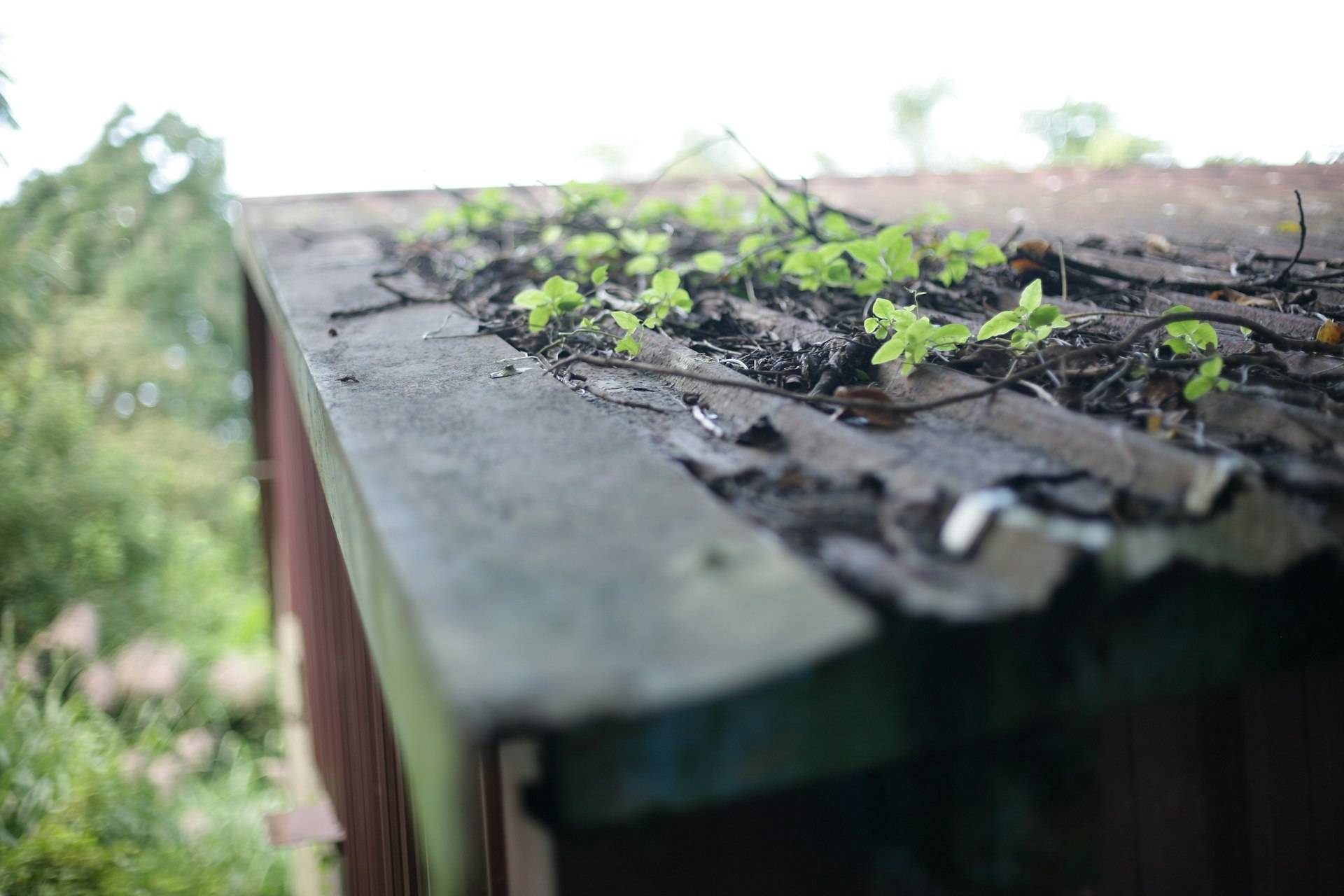
- Plants growing out of the trough. Unambiguous, and it means it has been building for at least a season.
What’s actually up there
It’s rarely just leaves, even though that’s the word everyone uses. A gutter left a season typically holds decomposed leaf matter, asphalt granules washed off the shingles above, wind-blown grit, and, once it has been sitting wet long enough, a dense black sludge from anaerobic decomposition. That’s the same process that happens at the bottom of an untended compost heap, which is why it smells the way it does.
Knowing this mostly matters for setting expectations. It won’t flush out with a hose, and it needs scooping with gloves rather than rinsing.
Note
Debris composition varies by region more than people expect. Pine needles mat into a felt that passes through screen guards; hail-stripped shingle granules pack into a dense layer ordinary rain won’t move. Our state guides cover the dominant debris where you live.
Why the outlet clogs before the trough
The trough is wide and the outlet is narrow, so debris traveling with water reaches the constriction and stops there. A gutter can hold a season of leaves along its run without overflowing at all, right up until the outlet closes.
This is also why a cleaning that only scoops the trough frequently fails to solve the problem. Clearing the outlet and confirming flow matters more than how clean the trough looks.
Overflow that isn’t a clog
Not all overflow is debris. If the gutter is genuinely clear and it still spills, the cause is capacity, pitch, or a blockage inside the downspout rather than at its opening. Our gutter overflow guide works through distinguishing them with a hose test.
Worth ruling out before paying for repeat cleanings that won’t fix it.
Clearing it safely
Ground-based tools — a telescoping wand, or tongs on a pole — handle single-storey homes with recent, loose debris reasonably well. Packed, wet debris from a full season generally still needs hands-on scooping.
Whatever the method, finish by running water through and confirming it reaches the downspout outlet at the bottom. A cleaning that doesn’t end with a flow check hasn’t confirmed the thing that actually matters.
See our DIY safety guide before doing ladder work, and our best cleaning tools if you’re trying to avoid the ladder entirely.
Want a pro to handle it?
The fastest way to learn what this job costs where you live is to have a few local contractors price it.
- Describe the job once and compare several local pros
- Quotes are free, and you're not committed to hiring anyone
- Worth doing even if you fix it yourself — it tells you what the work is worth
Sponsored link — we may earn a commission if you request a quote, at no cost to you. How we're funded
Compare gutter cleaning options on AngiYou continue on Angi to describe the project.
When a clog becomes something worse
Three failures follow from leaving it, and each costs considerably more than the cleaning would have:
Ice dams. In freeze climates, standing water trapped by a clog backs up under the shingle edge and freezes. A clog that’s a minor annoyance in October becomes a roof problem in January. Our ice dam guide covers the mechanism.
Fascia rot. Water overflowing at the same point for months runs down the board that hangers screw into. That’s how a cleaning problem turns into a repair that involves carpentry.
Foundation moisture. An overflowing gutter discharges along its whole length instead of at controlled points, delivering water directly against the wall. Our foundation drainage guide covers the consequences.
Preventing the repeat
Cleaning frequency should match your debris, not the calendar. Deciduous cover fits the standard twice-a-year rhythm; conifers shed year-round and need more. Our maintenance schedule has the matrix.
Guards help substantially on wooded lots and are close to pointless on open ones, and the type has to match your debris — a screen guard on a pine lot fails at exactly the job it was bought for.
Frequently asked questions
How do I know if my gutters are clogged without climbing up?
Overflow during ordinary rain is the clearest sign. Others visible from the ground: staining and streaking on the siding below the gutter line, a section sagging under debris weight, plants growing out of the trough, and water dripping from joints rather than running to the downspout.
What's actually in a clogged gutter?
Rarely just leaves. A neglected gutter typically holds decomposed leaf matter, asphalt granules washed off the shingles, wind-blown grit, and a black anaerobic sludge that forms once it has been sitting wet long enough.
Can a clogged gutter cause roof damage?
Yes, particularly in freeze-prone climates. Standing water in a clogged gutter can back up under the shingle edge and contribute to ice dam formation, which is a more serious and more expensive problem than the clog itself.
Where do gutters clog first?
The downspout opening, almost always. The trough can look clear along its whole length while the outlet is plugged solid, which is why clearing the trough alone often fails to fix the overflow.